
St Columba's Catholic Primary School
Speech, Language, Communicate
Speech, Language and Communication
is one of our Key Drivers at St Columba's School
Speech, language and communication skills are crucial to 'Young children's' overall development. Being able to 'speak' clearly and process 'speech' sounds to understand others, to express ideas and to interact with others are fundamental building blocks for a child's' development.
Speech - The expression of words, thoughts and feelings by articulating sounds.
Language - Communication by either speech or written word.
Communication - Sharing information by writing, speaking or through another medium.
Communication is fundamental to children's development; children need to be able to understand and be understood. Communication is the foundation of relationships and is essential for learning, play and social interaction. Communication Trust (https;//bit.ly/2WhOiG1).
Speech and language communication enables children to build positive relationships, form friendships and learn by listening, talking and questioning. Good speech, language and communication skills have a positive impact on confidence and self-esteem. By interacting and playing using speech and language, a child or young person develops social skills and friendships that support their well-being. As children learn and use new vocabulary, they gain confidence in speech and learn to express their feelings, which will mean that their needs are met. Good speech, language and communication skills support educational achievement and employment opportunities.
If a child or young person has difficulties with speech, language and communication, they are more likely to have difficulty in developing reading and writing skills, have behaviour difficulties and difficulty in forming friendships and making social connections. Difficulty in expressing themselves causes frustration and isolation. Many children and young people with speech, language and communication difficulties have significant behavioural difficulties or are withdrawn which may result in a negative impact on confidence and self-esteem. Poor communication has an impact on mental health, employment opportunities and links closely to poor educational achievement and poverty.
At St Columba's we hold speech, language and communication as one of our key drivers. We aim to feed it into all areas of the curriculum and life of the school. Children are screened on entry and support is put in place for those who are struggling.
The ShREC approach
1 July 2025
The EEF’s early years specialist Fliss James explains how educators can use the ‘ShREC’ approach to engage young children in high-quality interactions.

Fliss James
Content Specialist for Early Years
Supporting children to become better communicators is one of the most powerful things we do as early years educators. Oral language skills are fundamental to children’s learning, thinking and emotional wellbeing. Children who can communicate well can make friends, play, resolve conflicts and tell us how they are feeling. In the short term, children who are better communicators at age five become better readers. In the longer term, they go on to achieve better exam results at age 16 and are more likely to gain higher-paid employment as adults (Shuey and Kankaraš, 2018).
Prioritising communication and language development
Research tells us that we should prioritise the development of children’s communication and language through socially meaningful interactions. Children thrive on conversation with people they have a strong relationship with, focused on things they want to talk about.
High quality interactions often look effortless, but they are not easy to do well. The ShREC approach provides us with a simple and memorable set of specific, evidence-informed strategies which we can embed into everyday practice. We can use these strategies with every child, every day.
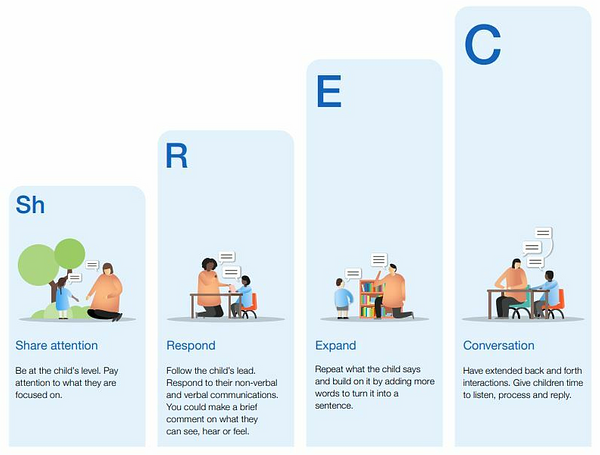
So, what happens during the ShREC approach?
Share attention
Tuning in’ and showing genuine interest in what a young child is focused on lets them know that you value and want to spend time with them. It is a powerful way to establish a connection.
Getting down to the child’s level and engaging in their choice of activity provides a crucial opportunity to pay attention to what they look at, what they do, and what they say. Sensitively joining in with a child’s play motivates them to communicate with you.
Respond
How we respond to a child once we have established joint engagement is dependent on our knowledge of them as a unique individual. Adaptive, attuned responses should be sensitive, supportive and stimulating. Educators should warmly acknowledge children’s verbal and non-verbal communication. Non-verbal responses may include eye contact, looking expectantly, nodding or smiling. Verbal responses may include narrating what the child is doing or commenting on what they can see, hear, feel. You may articulate the link between their activity and previous learning or experiences.
Expand
The ‘back and forth’ rally of engagement is getting underway: the educator and child are sharing attention, with the educator responsively following the child’s lead. This is where modelling and scaffolding begins, with the educator pitching their language just above the level of the child.
If a child gives a one-word response such as ‘dog’, we should expand on what they say. Educators can do this by repeating and building on this utterance by adding a few more words (‘Yes, it’s a dog. A small, brown dog’). This helps children to use more complex utterances. Your knowledge of the child will inform what may be helpful to model.
Conversation
The goal is to develop sustained back-and-forth conversations that involve many turns. The beauty and power of conversation is that it offers children an opportunity to practise talking and to receive feedback from an adult.
To encourage rich back-and-forth conversations: comment more, question less. When used sparingly, questions can be useful to cue turn-taking during conversation, especially ‘Wh’ (who, what, where, when) and open questions which invite children to elaborate.
As children’s conversational skills develop, we can sensitively challenge children, shaping the conversation to incorporate more abstract topics that are removed from the ‘here and now’.
These strategies encourage us to become more responsive and attuned to children. They encourage children’s active participation in meaningful, stimulating and linguistically rich back-and-forth conversations.